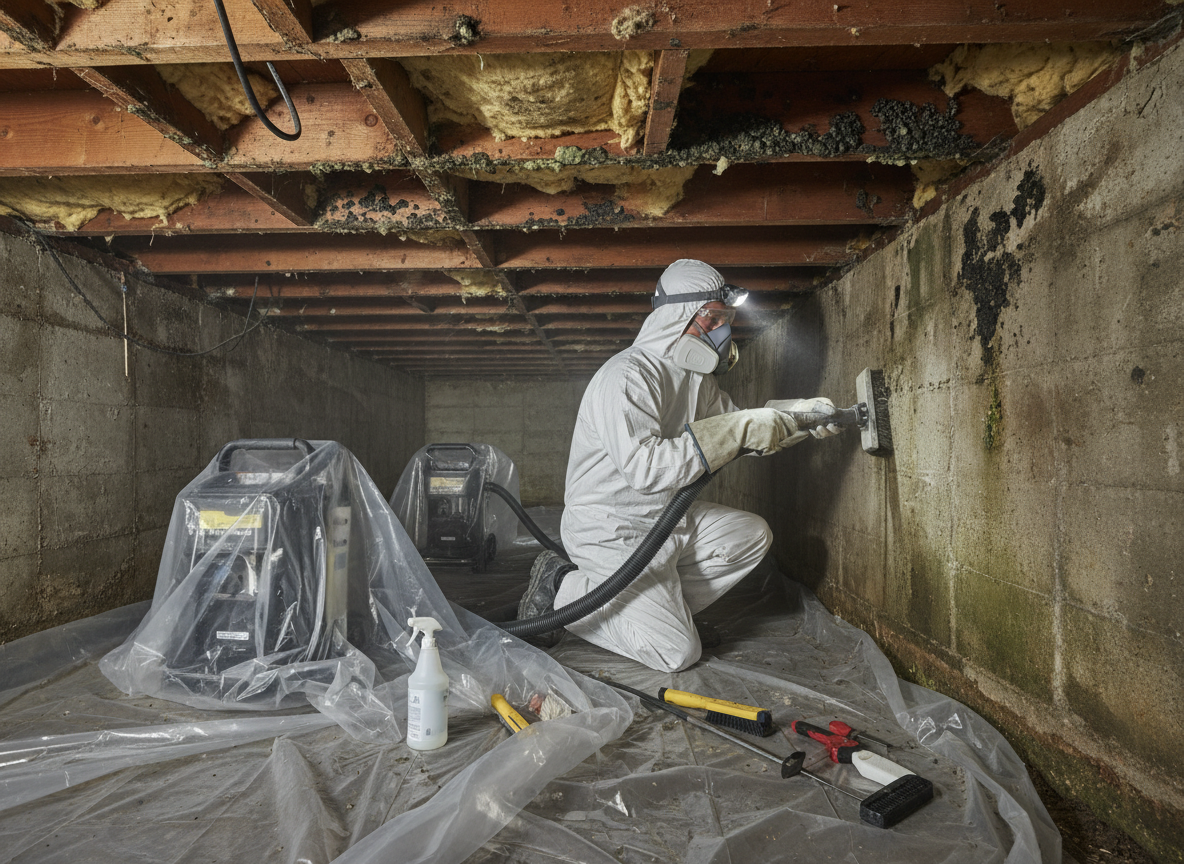
Crawl spaces in San Luis Rey homes often trap humidity from coastal air and seasonal rains, allowing mold to grow on joists, insulation, and soil. Older housing stock around the San Luis Rey River corridor frequently lacks modern vapor barriers, so moisture from the ground migrates upward and feeds colonies that later affect flooring and HVAC returns. Proper removal requires isolating the space, HEPA vacuuming visible growth, and applying antimicrobial treatments that reach behind pipes and ductwork without disturbing structural supports.
Access limitations in narrow San Luis Rey crawl spaces demand technicians use contained entry points and negative air machines to prevent spores from entering the home above. When insulation is saturated it must be removed in sealed bags rather than left to dry in place, because residual cellulose holds moisture long enough for regrowth. Local soil conditions with high clay content slow drainage after heavy rain, so any remediation plan includes checking perimeter grading and downspout extensions to reduce future water entry.
Preventing Recurrence After Crawl Space Mold Removal
Homeowners should add or replace vapor barriers and seal foundation vents once the mold is gone. In San Luis Rey, installing a dehumidifier sized for the actual square footage prevents the humidity spikes that return every winter.
Technician insight
In San Luis Rey, the thing that catches most people out with crawl space mold removal is how quickly coastal humidity re-wets the soil after we finish if the vapor barrier is missing or torn. Many homes built before the 1980s around Oceanside Blvd still have open dirt floors that let moisture climb straight into the joists every time it rains.
Hidden Growth Under Flooring
A San Luis Rey homeowner noticed musty odors near the laundry room. We found standing water in the crawl space from a clogged perimeter drain and mold on the subfloor joists. After removing wet insulation, treating all surfaces, and sealing the dirt floor with a new vapor barrier, the odor disappeared and humidity stayed below 55 percent.
How it works
- 1
Initial Inspection
Technicians enter the crawl space to map moisture sources, identify mold colonies, and note any compromised insulation or wood.
- 2
Containment Setup
Plastic sheeting and negative air machines isolate the work area so spores do not migrate into living spaces above.
- 3
Removal and Treatment
HEPA vacuuming, antimicrobial application, and removal of affected materials occur, followed by drying with air movers.
- 4
Final Verification
Moisture readings and visual checks confirm the space is dry and mold-free before barriers are reinstalled.
Pricing
Cost depends on crawl space size, depth of mold, and whether insulation or wood must be replaced.