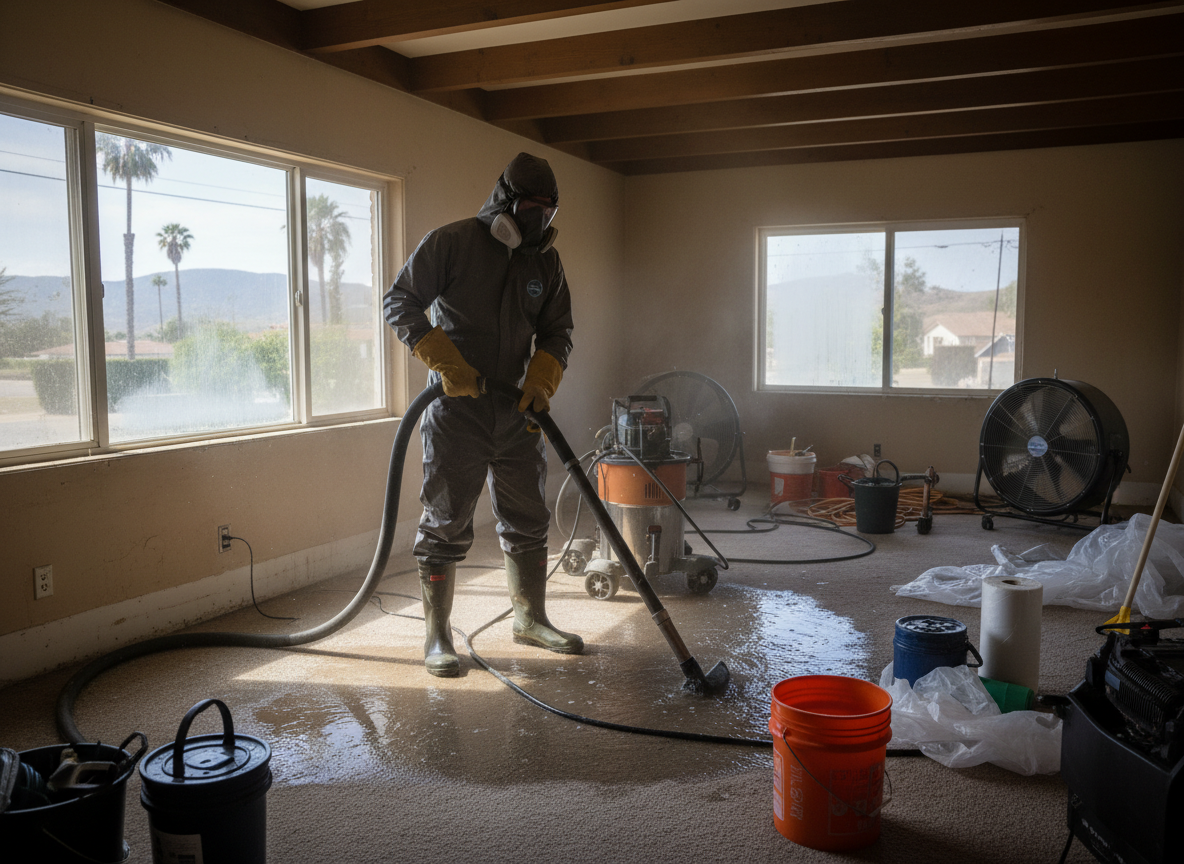
San Luis Rey sits in a low-lying section of San Diego County where winter storms send runoff from the surrounding hills straight toward older single-story homes built in the 1960s and 1970s. These houses often have original cast-iron or galvanized lines that corrode at joints, allowing water to travel under slab foundations and into adjacent rooms before anyone notices. Emergency water cleanup here starts with locating the hidden path the water took, because the sandy loam soil lets moisture spread farther than it would in clay-heavy areas farther inland.
Once extraction begins, crews must account for the mild coastal humidity that slows natural evaporation even on sunny days. Industrial air movers and dehumidifiers are positioned to pull moisture from drywall cavities and under cabinets where mold can begin in less than 48 hours. Homes along Mission Avenue and near the San Luis Rey River corridor frequently require floor removal because the particleboard subfloors swell and separate from the joists when water sits for even a short time.
Technicians also check for secondary damage to electrical outlets near baseboards and to HVAC returns that pull air from affected rooms. In many San Luis Rey properties the ductwork runs through crawl spaces that flood during heavy rain, so cleanup includes pulling standing water from those voids before it reaches the furnace or air handler. Every job ends with moisture readings documented on multiple surfaces so homeowners know exactly which materials were dried to industry standards.
Technician insight
In San Luis Rey the thing that catches most people out with Emergency water cleanup is how quickly water travels under the slab in the sandy soil along the river corridor. Older homes near Mission Avenue often have no vapor barrier, so moisture wicks into the drywall from below and you end up chasing it two rooms away from the original leak.
Slab Leak Under 1972 Ranch Home
A pinhole leak in the main line under a single-story house off Oceanside Blvd sent water across the slab and into the living room. Extraction revealed saturated particleboard subfloor extending into the hallway. Equipment ran for four days until readings stabilized, allowing the homeowner to keep the original oak flooring after minor repairs.
How it works
- 1
Arrival and Safety
Technician arrives within the hour, shuts off water if still flowing, and sets up containment to protect unaffected areas of the home.
- 2
Water Extraction
Standing water is removed with truck-mounted pumps and portable extractors, paying special attention to carpet pads and under cabinets.
- 3
Drying and Monitoring
Air movers and dehumidifiers are placed; moisture meters track progress daily until readings return to normal levels for the structure.
- 4
Final Assessment
All surfaces are rechecked and a written drying log is provided before equipment is removed.
Pricing
Upfront quote given after inspection; final cost depends on volume of water, affected square footage, and drying time required.