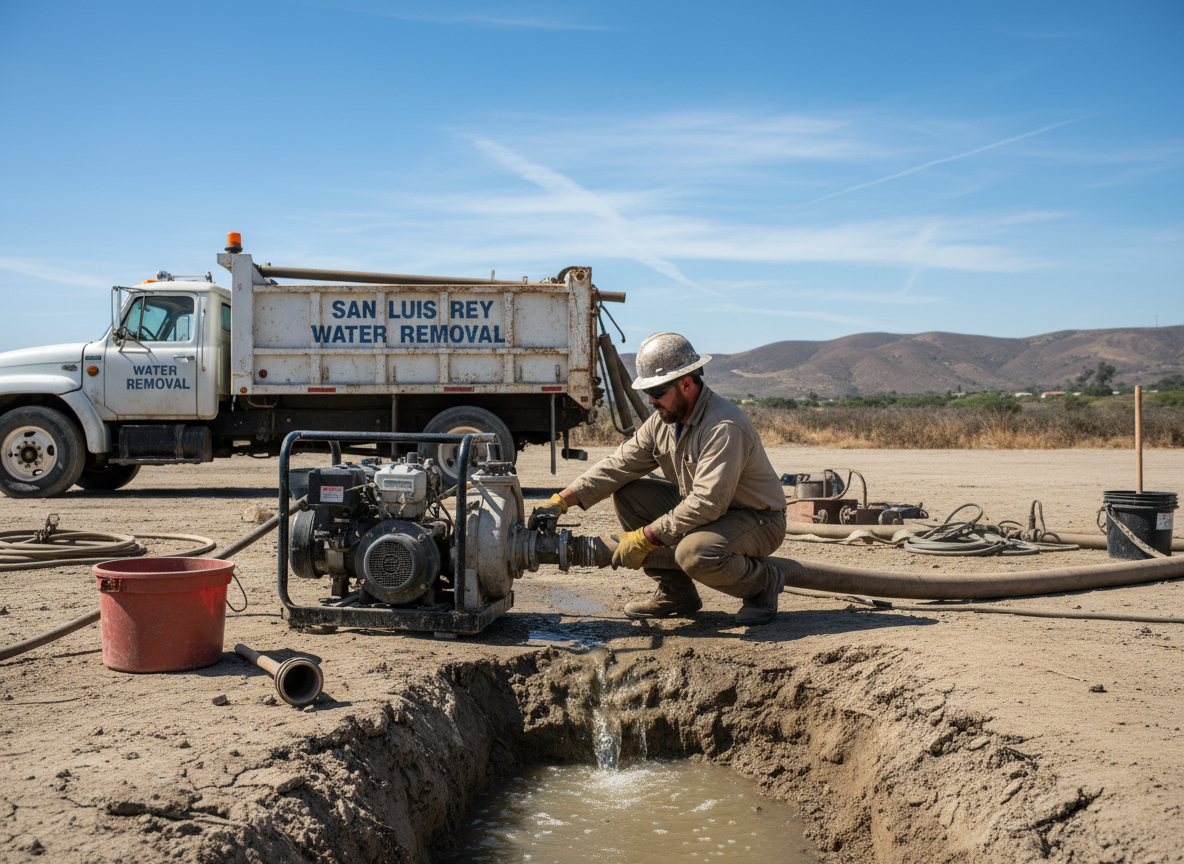
Water extraction in San Luis Rey often starts with older single-story homes built on raised foundations near the San Luis Rey River. These structures trap water under floorboards and in crawl spaces when monsoon rains or pipe failures occur, requiring submersible pumps and moisture meters to reach hidden pockets before mold sets in. Crews must account for the area's sandy loam soils that allow water to migrate laterally under slabs, turning a small kitchen leak into wall-to-wall saturation within hours.
Technicians extract water using truck-mounted units followed by air movers and dehumidifiers calibrated for the coastal humidity that slows evaporation in San Luis Rey neighborhoods. Edge cases include stucco exteriors that hide moisture behind weep holes and multi-unit buildings where water travels between units through shared plumbing chases. Proper containment prevents cross-contamination, and crews document moisture levels at each step to meet insurance requirements without over-drying wood framing common in 1960s-1980s homes here.
After initial removal, extraction teams focus on carpet pads and baseboards that hold the most water in San Luis Rey properties. Delaying this step allows capillary action to pull moisture into drywall, creating conditions for hidden rot along the base plates. Local operators know to check under appliances and behind water heaters, common sources of slow leaks that go unnoticed until floors buckle.
Technician insight
In San Luis Rey the thing that catches most people out with water extraction is how the river-adjacent clay pockets hold water under older slab homes long after the rain stops, so skipping perimeter checks around 4215 Oceanside Blvd properties often leaves hidden saturation that shows up weeks later as warped baseboards.
Overflow from washing machine in San Luis Rey duplex
Water spread under vinyl flooring into the shared wall. Extraction crews pulled back the flooring, used perimeter pumps to clear the crawl space, then ran drying equipment for four days until readings stabilized and prevented mold growth between units.
How it works
- 1
Initial Assessment
Technicians arrive within hours, locate the water source, and map affected areas using moisture detection tools.
- 2
Standing Water Removal
Industrial pumps and wands extract bulk water from floors, carpets, and hard surfaces.
- 3
Hidden Moisture Extraction
Crawl spaces, wall cavities, and under-slab areas are addressed with specialized equipment to prevent secondary damage.
- 4
Drying and Monitoring
Air movers and dehumidifiers run until readings return to normal, with daily checks to confirm progress.
Pricing
Pricing varies by water volume, access difficulty, and square footage affected.